If you have ever stood in a fitting room holding a dress that fits your hips but gaps at the bust, or zips up perfectly but pulls across the back, you already understand the difference: off-the-rack dresses are cut to a standard size chart, while made-to-measure dresses are cut to your actual body, and that single distinction changes everything about how a dress looks and feels on you.
This guide explains both options in plain English, with no jargon and no sales talk. We will look at how each type of dress is made, what “fit” really means, how to judge a dress in a fitting room, how design choices and timelines differ, and how to decide which route makes sense for your wedding, prom, evening event, or bridesmaid duties. By the end, you should have a clear picture of what you are choosing between, and what to expect from the made-to-measure process at A Dress Tailor if that is the path you take.
The Short Answer: Fit Is the Real Difference
The real difference between made to measure and off-the-rack comes down to one thing: whose measurements the dress is cut to. An off-the-rack dress is cut to a standard size chart, so it is designed to fit a hypothetical average body in that size, and then you are expected to adjust yourself to it or alter it afterward. A made-to-measure dress is cut to the measurements of one specific person, so the dress is adjusted to you before it is sewn, not after.
That sounds simple, and in a way it is, but the consequences ripple through everything else. Because an off-the-rack dress is cut to a standard, it can be tried on today and taken home today, and it can be returned or exchanged under the shop’s policy. Because a made-to-measure dress is cut to you, it usually cannot be tried on before it is made, it takes weeks rather than minutes, and it is generally non-returnable because it was made for one person only. Those trade-offs are real, and they matter. The question is not which option is “better” in the abstract; it is which set of trade-offs suits your body, your event, your timeline, and your tolerance for planning.
There is also a middle ground worth naming early, because people often confuse the terms. Many off-the-rack dresses can be altered by a tailor after purchase, and some shops offer “made to order” dresses where you pick a standard size and a standard design and the factory produces it for you. Neither of those is the same as made to measure. Alteration adjusts a finished garment; made to order in the standard-size sense still starts from a size chart. Made to measure starts from your measurements and builds the garment around them. Keeping those three ideas separate will make the rest of this article much easier to follow.
What Off-the-Rack Actually Means
Off-the-rack means the dress already exists in a finished form, in a range of standard sizes, and you choose the size closest to your body. The dress was designed and sewn before you walked into the shop, based on a size chart that a brand has decided represents its customers. When you buy it, you are matching yourself to the garment rather than the garment to you. This is how most clothing in the world works, and for everyday clothes it works well enough.
The great advantage of off-the-rack is speed and simplicity. You can see the dress on your body immediately, in real light, and judge the color and fabric with your own eyes. You can walk out with it the same day, or have it shipped in days rather than weeks. If it does not work out, return and exchange policies usually apply, subject to the shop’s terms. For a last-minute event, a dress you only need once, or a style you are still unsure about, that immediacy is genuinely valuable.
The limitation is built into the concept. A standard size chart has to compromise, because real bodies do not come in a small number of proportional shapes. Two women who both wear the same size might have very different bust-to-waist ratios, different shoulder widths, different torso lengths, and different hip curves. The dress is cut for an average of those differences, which means it will be close on most people and truly right on very few. That is why so many formal dresses end up at a tailor after purchase, and why the alteration bill is sometimes a meaningful fraction of the dress price. Off-the-rack is not a bad option; it is simply an option with a known set of compromises, and it helps to go in knowing what they are.
What Made to Measure Actually Means
Made to measure means the dress is cut and sewn for one customer, using that customer’s measurements, after the order is placed. Nothing is pulled from a shelf in your size, because there is no shelf involved. The maker takes your measurements, applies them to the design you have chosen, and produces a garment intended to fit you specifically. The design itself may be based on a photo, a sketch, or a style you have seen, but the pattern is built around your numbers rather than a size chart.
Because the dress is made for you, the fit conversation happens before sewing rather than after. Waist position, bust room, shoulder width, sleeve length, skirt length, and the way the bodice sits can all be planned around your body from the start. For formal wear, this matters more than it does for a t-shirt, because formal dresses are structured. A wedding dress or an evening gown often has a fitted bodice, a defined waist, boning or inner support, and a skirt that hangs from a specific point. When those elements are cut to a standard size, small mismatches show up as pulling, gaping, or a waistline that sits slightly off. When they are cut to you, those problems are largely designed out before they exist.
The trade-off is that made to measure asks more of you. You need to provide accurate measurements, you need to allow weeks rather than days, and you need to accept that the dress is yours once it is made, which usually means it cannot be returned. You also give up the instant try-on: you will not see the finished dress on your body until it arrives. For many people planning a wedding, prom, or a significant evening event, that trade is worth it, because the dress is the point rather than an afterthought. For others, the speed and flexibility of off-the-rack matter more. Neither choice is wrong; they simply serve different situations.
Fit: Standard Sizes vs Your Own Measurements
Fit is where the two approaches diverge most visibly, and it is worth learning to see it, because a well-fitting dress and a poorly fitting one look completely different even when the design is identical. The good news is that you can train your eye in a single fitting-room session. The skill is not complicated; it is mostly about knowing where to look and what the fabric is telling you.
Start with ease, which is the extra room between your body and the garment. A dress should not be skin-tight anywhere it needs to move, and it should not hang away from you where it is meant to follow your shape. Check the bust, waist, and hip areas by sliding a finger or two under the fabric at the seam lines. If you cannot slide a finger under comfortably, the dress is too tight there; if you can gather a fistful of fabric easily at a point where the dress is supposed to be fitted, it is too loose. Next, look at the shoulder seam. On most dresses, the shoulder seam should sit at or very near the edge of your shoulder bone, not hanging off the end of your arm and not creeping toward your neck. Shoulder position is one of the hardest things to alter later, so it is worth checking carefully before you commit.
Then check the closures. Zip the dress up and look at the zipper from the side. A zip should close smoothly and lie flat against your back or side without pulling apart at the top or forming a gap. If the zip will not close without force, or if it closes but the fabric around it strains, the dress is too small in that area, and no amount of tugging will fix it. Finally, learn to read stress lines. Horizontal wrinkles or pull lines radiating across the bust, waist, or hips usually mean the garment is too tight in that spot, because the fabric is being stretched between two points. Vertical folds where the dress should be smooth can mean it is too loose or cut for a different body shape. Gaping at the neckline or armhole, where the fabric stands away from your chest or back, usually means the bodice is cut for a larger bust or a different shoulder slope than yours. None of these are moral failings of your body; they are simply the dress telling you it was cut for someone else. Once you can spot them, you can judge any dress in minutes, and you will understand exactly why made-to-measure exists.
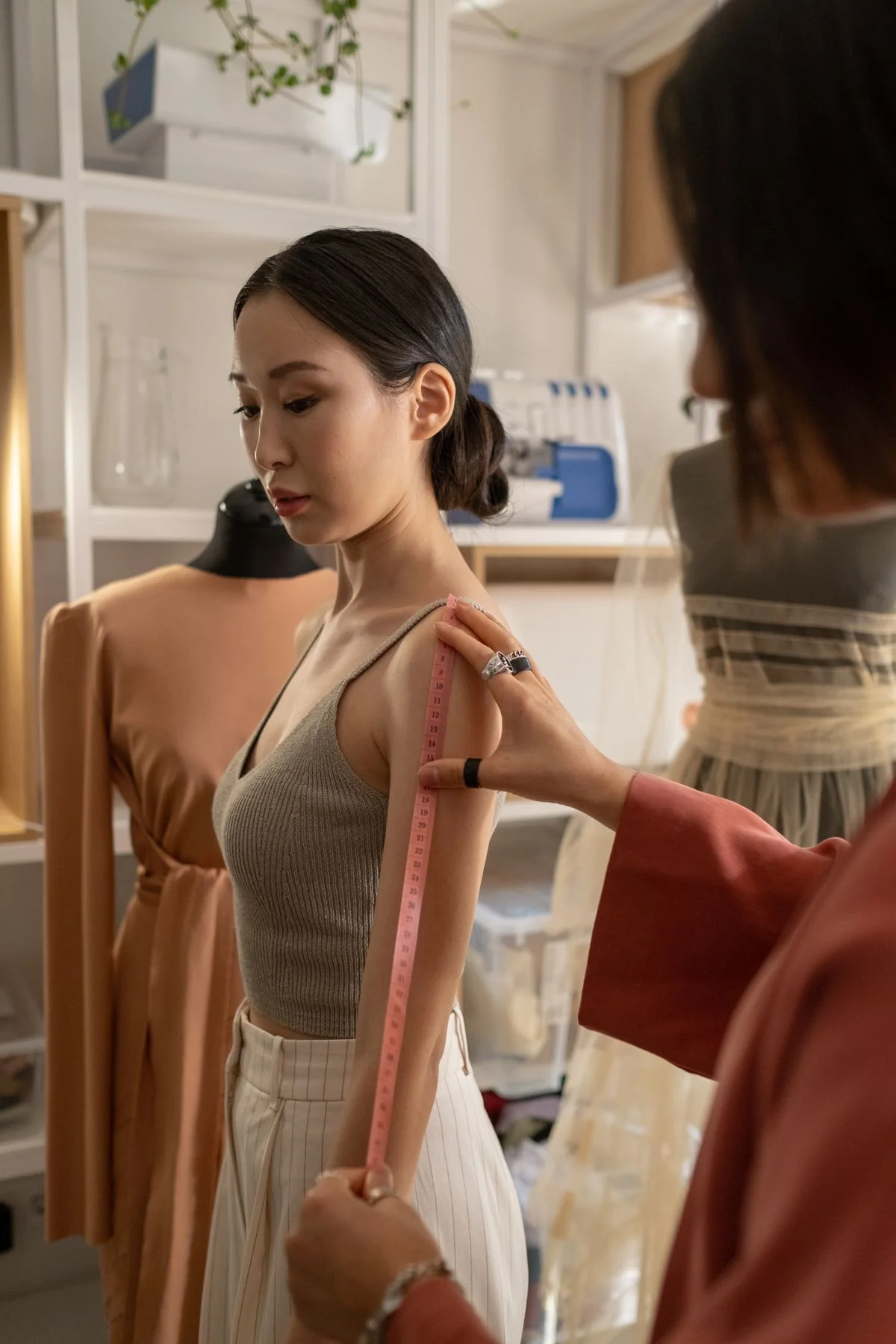
For the step-by-step method, read our guide on how to take your measurements for a custom dress at home.
Design Choice and Changes
Off-the-rack gives you the design that already exists, in the color and fabric the shop or brand has chosen, and your choices are essentially yes or no. That is not a criticism; a well-designed dress in a color you love is a perfectly good outcome, and seeing it in person before buying is a real advantage. But if you want a different sleeve length, a higher or lower neckline, a different skirt shape, or a specific color, off-the-rack usually cannot accommodate you. What you see is what you get, and any changes after purchase mean alterations to a finished garment, which are limited by how much fabric the dress has and how its seams are constructed.
Made to measure opens up the design conversation, because the dress is being built rather than selected. Within reason, elements like sleeve style, neckline shape, skirt length, and color can be discussed and planned before sewing begins. This is where a custom dress earns its keep for people who have a clear picture in mind, or who have tried on many off-the-rack dresses and found that each one was almost right but not quite. It is also helpful for anyone whose body makes standard sizing frustrating, because the design and the fit can be solved together rather than fought over separately.
One honest note: made to measure is not a magic photocopier. If you send a photo of a design you love, the result will be a dress made in that style and spirit, adapted to your measurements and to what is practical in construction, but it will not be a guaranteed one-hundred-percent identical copy of the photo. Fabrics, trims, and small construction details may differ, and the maker will tell you honestly if something in a photo cannot be reproduced exactly. The goal is a dress that captures what you loved about the design and fits you properly, not a counterfeit of someone else’s garment. Knowing that upfront keeps expectations healthy on both sides.
Time, Planning and Alterations
Off-the-rack is fast. You can buy a dress today for an event next week, and if it needs small adjustments, a local tailor can often handle them in days. The planning burden is low, which is exactly what you want for a last-minute invitation, a dress you will wear once, or a style you are still deciding about. The hidden cost is alterations: many formal dresses need some tailoring after purchase, and those costs and turnaround times are worth factoring in before you decide the off-the-rack price is the whole price.
Made to measure runs on a different clock. At A Dress Tailor, making time is typically three to six weeks from the point your order is confirmed, and that window is for the making itself, so it should be planned alongside shipping time rather than instead of it. The process is deliberately staged so nothing is rushed: you inquire through the website form, by email to [email protected], or by WhatsApp at +86 17371660548; you send reference photos by email or WhatsApp only, since the website does not have a file upload feature; a fifty percent deposit is paid by PayPal invoice; the dress is made; finished-dress photos are sent to you for confirmation; the balance is paid; and then the dress ships with a tracking number. Each stage exists so that you see what is happening and can confirm before the next step.
The planning implication is simple: start early. If your event is in three months, made to measure is comfortable. If it is in three weeks, it is tight and may not be possible, and off-the-rack plus alterations is the safer route. It also helps to build in a little buffer for the confirmation stage, because that is your chance to review the finished dress in photos and raise any concerns before it ships. Custom dresses are non-returnable unless there is a quality problem, so the confirmation step is not a formality; it is your safety net, and it works best when you have time to use it properly.
Which Should You Choose? A Simple Decision Guide
Choose off-the-rack if speed and flexibility matter most to you. If your event is soon, if you want to see and try the dress before committing, if you are still exploring styles, or if you are comfortable with a standard size plus a trip to a tailor, off-the-rack is a sensible and often excellent choice. It is also the right call if you might change your mind about the dress, since return and exchange policies usually apply to standard purchases in a way they cannot for custom work.
Choose made to measure if fit is the priority and you have time to plan. That includes anyone who consistently struggles with standard sizing, anyone who has a clear design in mind, anyone who wants a dress built for a specific event like a wedding, prom, or bridesmaid role, and anyone who would rather solve fit before sewing than after. It also suits people who are comfortable with a staged process: measurements, deposit, making, photo confirmation, balance, shipping. If you can start early and you value a dress that is cut to you, made to measure is the more satisfying route.
A simple way to decide is to ask yourself three questions. First, how much time do I have? Second, how confident am I that a standard size will fit me well enough without major alteration? Third, how much does the dress itself matter to the event? If time is short, go off-the-rack. If time is reasonable and standard sizing has failed you before, go made to measure. If the dress is central to the day, made to measure usually justifies the extra planning. And if you are genuinely torn, ask before you order; a short conversation about your event date, your measurements, and your design idea will usually make the answer obvious.
How Ordering Made to Measure Works at A Dress Tailor
At A Dress Tailor, every dress is made to order for one customer through our custom design service, one piece at a time. The process starts with an inquiry through the website form, by email to [email protected], or by WhatsApp at +86 17371660548. You share your design idea and any reference photos by email or WhatsApp only, since the website does not offer a file upload, and you will get a straightforward conversation about what is possible, what it will involve, and what information is needed from you.
Once the details are agreed, a fifty percent deposit is paid by PayPal invoice, and making begins. Making time is typically three to six weeks. When the dress is finished, photos of the finished dress are sent to you for confirmation, so you can review it before the final step. After you confirm, the balance is paid, and the dress is shipped with a tracking number so you can follow it to your door. Custom dresses are non-returnable unless there is a quality problem, which is why the confirmation stage matters and why it is worth reviewing the photos carefully and asking questions at that point.
That is the whole process, and it is intentionally simple. There are no hidden stages and no surprises: inquiry, photos, deposit, making, confirmation, balance, shipping. If you are unsure whether made to measure suits your timeline, ask early with your event date in hand, and you will get an honest answer about whether the schedule works. The goal is a dress that fits you and arrives when you need it, and the process is built around those two things.

Frequently Asked Questions
Is made to measure the same as bespoke?
No, they are related but not identical. Bespoke traditionally involves a pattern drafted from scratch for an individual, often with multiple in-person fittings during construction. Made to measure uses your measurements to produce a garment built for you, typically from an existing design or style adapted to your numbers, usually without in-person fittings. For most formal dresses, made to measure offers the fit benefits people actually want without the length and cost of a fully bespoke process.
What if my measurements change?
Measurements can change, which is why it is worth taking them close to the time you order and mentioning any planned changes, such as weight changes or pregnancy, before the dress is made. If your measurements change after the order is placed but before making is complete, contact A Dress Tailor as soon as possible by email or WhatsApp to discuss options. Once a custom dress is finished, small adjustments may still be possible with a local tailor, but larger changes are limited by the fabric and construction, so early communication is always better.
Can an off-the-rack dress be altered to fit like made to measure?
Sometimes it can get close, but it is not the same thing. A skilled tailor can take in seams, shorten hems, adjust straps, and refine the fit of a finished dress, and the results can be very good. However, alterations are limited by how much fabric the dress contains and how it is constructed; you cannot easily add room where there is none, change the shoulder position dramatically, or redesign the bodice. Made to measure solves those issues before sewing, which is why it usually produces a closer fit for people whose bodies differ from the standard size chart.
How many measurements do I need to give?
The exact list depends on the design, and you will be guided through it during the inquiry. In general, expect to provide the core measurements a dressmaker needs to build a fitted garment, such as bust, waist, hips, and height, along with any design-specific measurements the style requires. Clear photos of you in fitted clothing, sent by email or WhatsApp, help the maker interpret the numbers correctly. If you are unsure how to measure yourself, ask for guidance before you send anything; accurate numbers at the start save time later.
What if I am between standard sizes?
Being between sizes is one of the most common reasons people choose made to measure. In off-the-rack, you usually have to size up and alter down, or accept a compromise in one area to get a fit in another. With made to measure, there is no size to be between: the dress is cut to your actual measurements, so the in-between problem simply does not arise. If you are consistently between sizes, that is a strong signal that made to measure will serve you better than standard sizing plus alterations.
Related Articles
How to Take Your Measurements for a Custom Dress at Home
Accurate measurements are the single biggest reason a made-to-measure dress fits well. You do not need a tailor or any special equipment: a soft measuring tape, thin clothing and about fifteen quiet minutes at home are enough. This guide walks through every measurement we ask for.
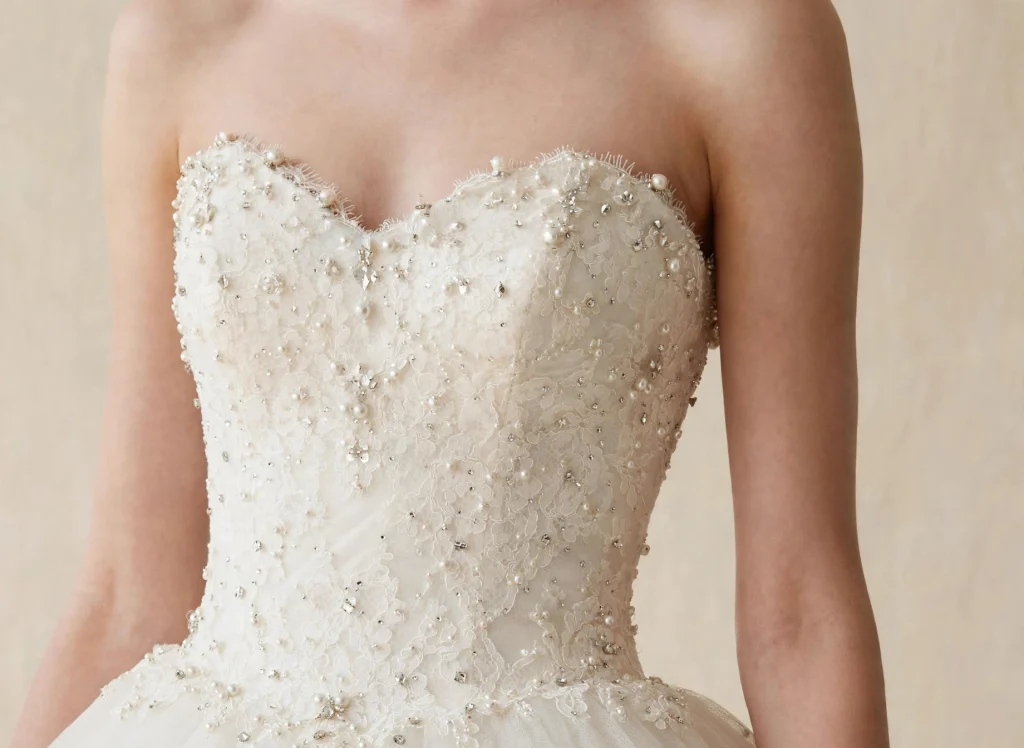
How Much Does a Custom-Made Wedding Dress Cost? What Actually Drives the Price
A custom-made wedding dress has no single price tag. Fabric, lace and embellishment, silhouette and structure, made-to-measure fit work, and the finishing details each move the quote — here is how, and how your final price is confirmed before you pay.
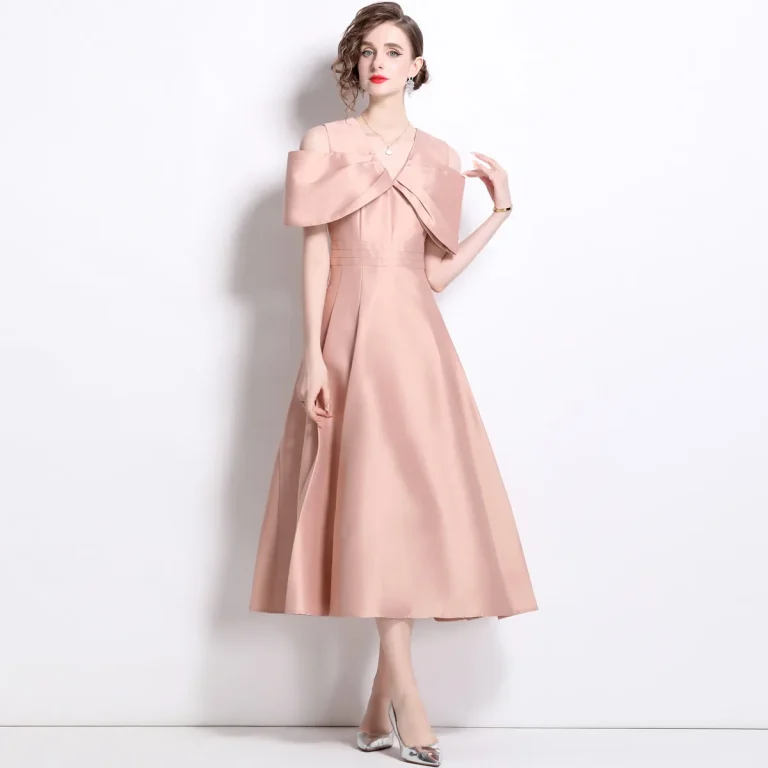
Ordering a Dress From a Photo: What to Send and What Happens Next
A clear set of photos and a few honest details is all it takes to start a custom dress. Many of our favourite orders began as a screenshot: a gown you loved, a neckline you cannot find in your size. This guide explains what to send for the most accurate first quote.
How Long Does a Custom-Made Dress Take? From First Message to Delivery
From your first message to a finished dress at your door, a custom-made order moves through clear stages — and the making itself typically takes 3–6 weeks. This guide breaks down each stage, from quote and deposit to final delivery, so you can plan backwards from your event date.